Get Started with Insightech
Account Setup with Insightech
How Insightech Works
Insightech Platform Walkthrough
Uncover Insights with Insightech
Manage your Account
Implement Your Tracking Code
Profile Settings & Cross-Domain Tracking
Manage Users and Roles
Set Up Conversion and Revenue Tracking for Reports
Reset Your Account Password
Submit a ticket
Platform User Guides
Dashboards & In-Platform AI Assistants
Insightech AI and Connecting via MCP
An Overview of Your AI MCP Connection
Your Insightech MCP User Guide & Key Concepts
How To Setup - Claude MCP Connection
How To Setup - Microsoft Copilot MCP Connection
How To Setup - Gemini Enterprise MCP Connection
How To Setup - OpenAI (ChatGPT) MCP Connection
Troubleshooting Your MCP Connection
Security & Privacy MCP Connection Information
Session Replays & On-Page Analytics
What are Session Replays?
Saving Notes, to Share Insights with the Team
What are Click Map Reports?
What are Scrolling Heat Maps?
Understanding Rage Clicks
Page Analysis Reports Explained
Form Analytics Explained
Funnels Explained
Pathing Reports Explained
Filters and Segments
Using Filters & Segments to Compare Audiences / Behaviours
Create your First Conversion Segments
Point and Search with Insightech
CSS Selectors Explained & How to Use Them
Saving Custom Reports
Notes & Insights
Data Layers Explained
Insightech Chrome Extension
Error Monitoring
Integrations
Insightech and AB Tasty
Insightech and Adobe Target
Insightech and Convert.com
Insightech and Insider One
Insightech and Optimizely
Insightech and Shoplift
Insightech and VWO
Insightech and Intelligems
Insightech and LaunchDarkly
Insightech and Dynamic Yield
Insightech and Magnolia
Optimisation Playbook
Analysing Website Abandonment with Funnels
Find and Recreate Customer Support Issues
Track Website Interactions with Funnel Analysis
Find and Analyse Dynamic Content
Analyse Website Content Engagement
Frequently Asked Questions
Privacy and Security
- All Categories
- Platform User Guides
- Data Layers Explained
- Data Layers Explained
Data Layers Explained
A data layer is a consistent layer of structured information behind the scenes of your website. It acts as a common dictionary of information that can be used to drive user experience and support digital marketing and analytics applications.
This might include information like:
- Products in carts
- Order IDs
- Customer IDs (anonymised)
- Page details and categories
- Google Analytics events (via GTM dataLayer)
- AB testing campaign names or attributes
Tracking your Data Layer
By default, Insightech tracks your data layer object out of the box so that you can use this information for our free-text search, segments and filters.
- If your data layer has the default name of "dataLayer" then Insightech automatically captures everything that is pushed into this object.
- If you are using a custom data layer name, you will need to setup your Insightech profile to identify your custom data layer name.
Data Layer Example
This is an example of what is shown in your data layer.
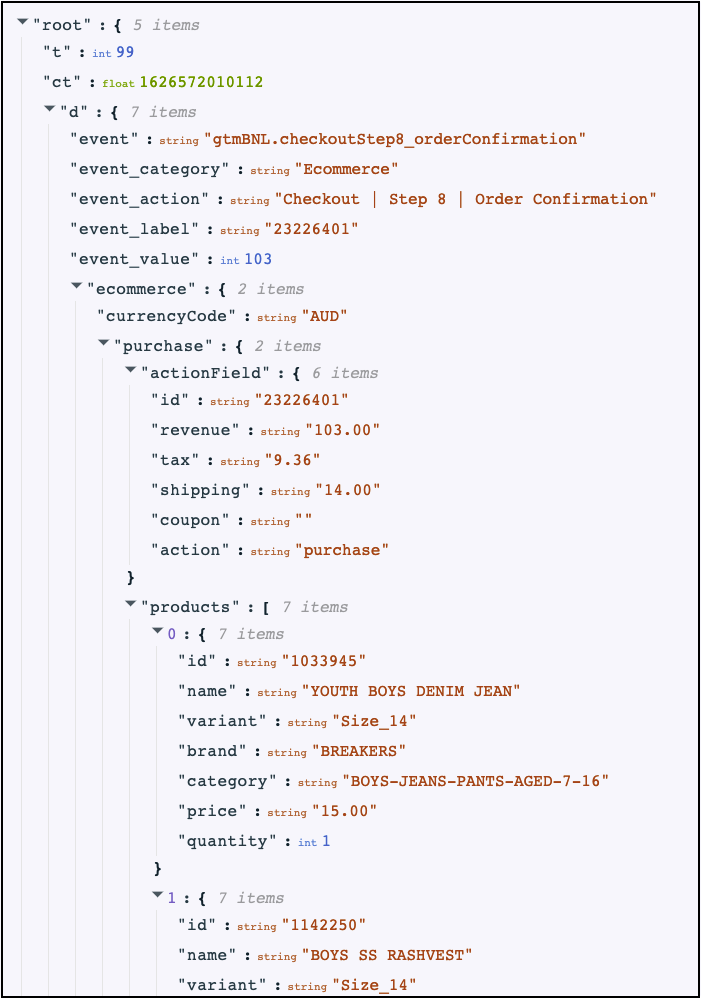
In this example, we can see multiple attributes that we can search for:
- event_category
- event_action
- event_label (order ID)
- ecommerce - currency code
- ecommerce - purchase details
- ecommerce - products in order
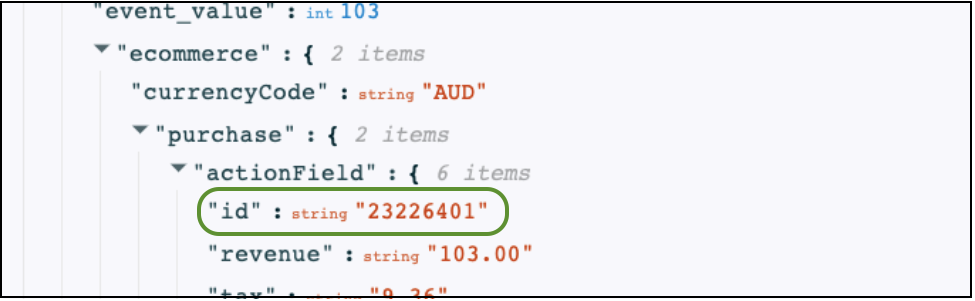
Notice that data points either, don't have any layers under them (e.g., event_action)or are multiple layers deep (e.g., ecommerce → purchase → actionField → ID).
How to Search for Data Layer Events on Insightech
Insightech will use the data layer to search through events on your website.

Follow these Steps
- Select Data Layer Event from the events drop down list
- Select JSON Path
- Enter the path of the attribute
- Select your condition (is/ contains /etc.)
- Input the value you want to search for
Example: Data Layer Event Search on Insightech
In the example below, we might want to search for the order number, stored under ecommerce → purchase → actionField → ID.
The JSON path of this element is ecommerce.purchase.actionField.id, and we would set it to look for the value 23226401.